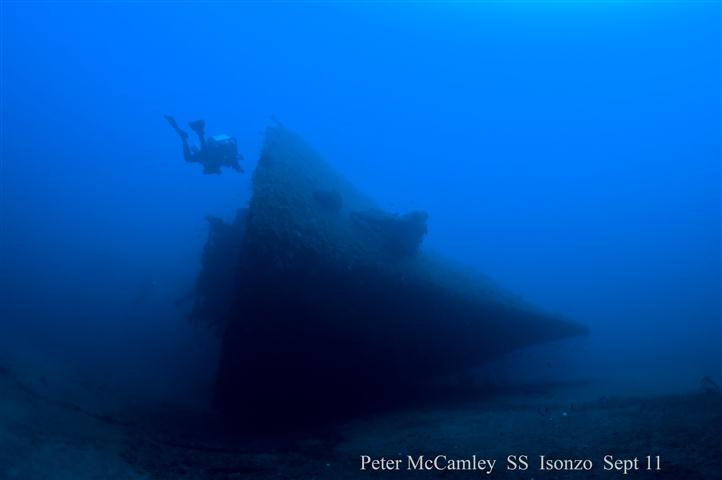
|
|
|
The Audacious (23,000 Tonne) |
|
|
|
Due to the Admiralty's concern at the inadequate U-boat defenses of the Grand Fleet's main base at Scapa Flow, the most of the British fleet had actually spent the first few months of the war based at Lough Swilly on the Northern Irish coast, until the base at Scapa Flow could be secured.
In August 1914 the German Liner “Berlin” was taken in hand for conversion to an auxiliary mine-layer. Towards the end of September she set off from Wilhelmshaven on her first mission but turned back after spotting some British warships. On October 16 Berlin set off again on another mission, this time to lay mines in the Firth of Clyde.
Berlin made her way to the Irish Sea but a combination of extinguished coastal lights, used for navigation, and a large amount of British warship traffic convinced Captain Pfundheller that he would be unable to reach his target area.
At this stage he decided to lay his mines in the nearest shipping lane, which was near Tory Island and Loch Swilly on the north coast of Ireland. Berlin laid over 200 mines in a V shape and then left the area, heading for Norway via Iceland. Fuel problems forced Berlin to seek internment in Trondheim, Norway, on 26 October.
At this time it was totally unknown to the German command that the British Grand Fleet was using Loch Swilly as a base whilst the main base at Scapa Flow in the Orkney Islands was having its feeble defences against submarine attack improved.
Early in the morning of 27 October 1914 Vice Admiral Warrender took the Second Battle Squadron, consisting of the "super-dreadnoughts" Centurion (flagship), Ajax, Audacious, King George V, Orion, Monarch and Thunderer, out of Lough Swilly on a gunnery exercise. This was to prove an expensive and costly decision.
At approximately 08.45am, under the control of Captain Dampier, as Audacious was doing a portside turn there was a huge thud! At first it was not clear that it was an explosion. During the turning maneuver the ship began to be non responsive to the controls and refused to herself correctly from the turning maneuver. Immediately it became clear that all was not as it should be.
The order to close watertight doors was given. The mine had struck on her port side just forward of the after engine room bulkhead. To counter the flooding some starboard side compartments were flooded but the ship still developed a 10-15 degree list. Captain Dampier set course for Loch Swilly at the best manageable speed on 9 knots but steering was hard.
The flooding was spreading, the central bulkhead which at first had contained the flooding was leaking and water was spreading into the ships central compartments and by 10.00am the central engine room was 5 foot deep in water and shortly after this the starboard engine room had to be abandoned leaving the dead in the water and eventually without any steam power for auxiliary machinery.
All but 250 essential crew were evacuated via the White Star liner SS Olympic and the light cruiser HMS Liverpool. At 14.00 SS Olympic made an attempt to tow, but the Audacious was pulling hard and the tow line broke. Attempts to tow were also made by HMS Liverpool and the collier Thornhill but on both occasions the attempt failed.
By 17.00 it was getting dark and at this time, all but the last 50 crew were removed. At 18.15 the mighty brand new diamond in the British Admiralty’s fleet was abandoned. For most of the day Audacious had not increased her list but was sinking by the stern. At 18.50 her list was seen to reach 30 degrees and at 20.45 she capsized. Quarter of an hour later there was a large explosion, thought to be either A or B magazine, followed by two secondary explosions and Audacious finally sank.
Later that evening Olympic dropped her anchor in Lough Swilly to disembark the rescued crew of the Audacious. For reasons of security the Olympic was ordered to remain out of sight of the Grand Fleet so that any passengers with any pro-German sympathies would be unable to observe any military activities.
In fact there were quite a number of German born Americans on board who had witnessed the demise of the battleship, and it was clear that they could not be relied upon to keep their silence. It was not possible to arrest or intern them all, as they were now American citizens, but if nothing else they could at least be detained for questioning when the passengers were disembarked.
Needless to say, the interrogations were not rushed
Although thankfully no lives had been lost, the sinking of Audacious was a serious blow to the British Fleet. Amazingly, the only real casualty during the entire incident had been Petty Officer William Burgess of HMS Liverpool. He was killed while standing on the deck of his own ship when he was hit by a 2 ft x 3 ft piece of armour plate when the Audacious blew up.
As the decks of the cruiser had been particularly crowded at the time it was considered a miracle that no one else had been killed, or even injured.
All enquiries about the ship itself were ignored and in the meantime Captain Dampier of the Audacious assumed command of the battleship HMS Superb, while his crew was transferred to the newly commissioned battleship HMS Queen Elizabeth.
It is well worth mentioning that at the time of the Audacious sinking, several other British battleships were suffering from engine problems and several others were so new that they were not fully efficient yet. This meant that the British Fleet was much weaker in reality than was advised on paper. The Grand Fleet Commander-in-Chief Admiral Jellicoe proposed that the loss was kept secret.
This request was backed by the British Foreign Office who were keen to avoid the bad publicity for diplomatic reasons whilst trying to influence the then neutral Ottoman Empire and the request was agreed by the British cabinet. The loss of Audacious was not admitted until after the war and Audacious continued to appear in fleet lists. This censorship turned out to be a waste of time because on board SS Olympic had been many Americans who had witnessed and photographed much of the incident. When back in America and outside the reach of British censorship the loss was soon reported in the press. Soon everyone except the British acknowledged the loss and the continued British silence on the subject did the creditability of the British authorities damage.
At the time of the sinking, it was thought that Audacious had hit a floating mine disturbed by either Ajax or Centurion although a torpedo attack was not completely ruled out. The inquiry also found that the main reason for the loss was lack of strength in the longitudinal bulkheads which should have prevented flooding spreading. This resulted in the bulkhead buckling and made it impossible to close some of the watertight doors and valves necessary to stop the water spreading.
Note: After laying the mines, Berlin attempted to return to Germany, but in the end was forced to put in to Trondheim where the ship was interned for the duration of the war. After the war the vessel was purchased by the White Star Line and renamed Arabic (the third company vessel to bear the name). She remained in service (alternating between the White Star Line and the Red Star Line) until 1931, when she was sold for scrapping at Genoa. Below are the Audacious' specifications. |
|
|
Displacement (loaded) > |
25,700t deep load |
|
Top Speed |
21 kts |
|
Range |
6,730 nautical miles at 10kts |
|
Armour - deck |
4in-1in |
|
- belt |
12in-8in |
|
- bulkheads |
10in-4in |
|
- barbettes |
10in-3in |
|
- turret faces |
11in |
|
Length |
597ft 6in |
|
Armaments > |
Ten 13.5in 45 calibre Mk V guns
Sixteen 4in 50 calibre Mk VII gusn
Four 3pdr guns
Three 21in submerged torpedo tubes (2 beam, 1 stern) |
|
Crew complement |
782 |
|
Launched > |
14 September 1912 > |
|
Completed |
October 1913 |
|
Sunk by mine |
27 October 1914 > | |
|
|
| A Trimix dive to the RMS Justicia |
|
Diving on RMS Justicia on 19th October.
Skipper: Michael McVeigh on The Ros Guill info@rosguill.com
Divers:
John Phillips
John Malone
Fintan Lowery
Rez Soheil
Peter McCamley
HISTORY
It was just before two o'clock in the afternoon on July 19th 1918, when one of two torpedoes fired from a German Submarine ploughed into the RMS Justicia as she passed Fannad Head, Co Donegal. She had been traveling unladen from Belfast to New York, after being converted into a Troop Ship by the British Admiralty. The submarine, Type III Coastal U Boat UB 64, was under the command of Lieutenant Von Schrader.
After the torpedo had made a direct hit on the ship, severe damage was caused. However due to the build of Justicia, although wounded, she limped on heading to the relative safety of Lough Swilly.
Von Schrader was deeply disappointed that his efforts had gone unpaid and at the risk of being depth charged from the escorting vessels, he continued with another attack some two hours later. Stalking beneath the waves, on his second attack, he fired two more torpedoes at the limping Justacia. The crew waited patiently for the "boom" that would signal a hit. After what seemed an eternity, the sound that was so eagerly awaited arrived. Von Schrader raised the periscope wanting to see the last of the Justicia disappear beneath the water.
As the periscope glass cleared, Von Schrader could not believe his eyes. The mighty Justicia, now having received three direct hits was still afloat. I am sure Von Schrader must have though to himself "if at first you don't succeed……"
After this second attack The Justicia had lost most of her power and was taken in tow by the tug, HMS Sonia, which made for the Lough Swilly. Over the next two hours, Von Schrader played a game of cat and mouse with the wounded Justicia. The escort vessels belonging to Justacia dropped their deadly cargo of depth charges. They played cat and mouse with Von Schrader and his crew.
Just before 8pm in the evening, Von Schrader made a third attempt to sink the Justacia. Just as before, he launched two more torpedoes at The Justacia and just as before, both torpedoes found their desired target. With five direct hits, like before, the mighty Justicia would just not sink.
At around 10.00pm, the U Boat Commander knew that his luck was running out. The more torpedoes he fired, the bigger the chance of his position being found and subsequently he and his crew would perish. He decided that he would bring the Justicia into line, fire his torpedoes and then head out to sea. This he did and as such reported that he could not see if the torpedoes had done their work. They had not, he had missed.
At around 3.00am, he steered a course towards Lough Swilly in order to launch a fifth attack. He raised the sub's periscope and got ready for the attack run.
As he moved into an attack position, he noticed two sets of water wash, off to his port side. He immediately realized that these two sets of water wash were from two more torpedoes, fired from a sub, adjacent to him. Another German U Boat Commander from UB124 was about to steal Von Schrader's glory. The two torpedoes were the straw that broke the camel's back and the mighty Justacia had taken as much as she could.
The sinking of the Justacia was one of the finest examples of the build quality that came out of Harland & Wolfs dock in neighboring Belfast. It was solely due to this fact that the skeleton crew were allowed the time to be taken off, before she disappeared.
The exact source of these two torpedoes is unclear. Two other German submarines were in the vicinity, according to accounts of the sinking recorded by Ian Wilson in his book Donegal Shipwrecks. The most likely candidate is the UB-124 which shortly afterwards surfaced accidentally, only to be sunk by three of the Justacia escort party. Another candidate is U-54, under the command of Lieut Cmdr Von Ruckteschell, which was also in the locality at the time that the Justicia was sunk.
It was later told by one of Sonia's crew "she sank stern first, with the pressure of escaping air from he submerged hull blowing off the air ventilators. As she sunk you could hear the hisses came from outlets. It was as if the mighty Justacia was taking her last breath".
Today, I am on the boat of Michael Mc Veigh, skipper of the Ros Guill. We had planned to dive another wreck, The Vicknor, which was slightly deeper than the Justacia. However due to the weather at the last minute there was a change of plan and we are heading out some 22 miles from The Downings to dive the Justacia. My mix is 14/55, with deco stages of 84% O2 and 44% O2. My bottom gas has been mixed for a depth of 87 meters. As the Justacia is around 72 meters, my mix is slightly rich. My head will be very clear at depth; however I will have additional decompression time to do.
The bottom time on the wreck will be 20 minutes. According to the Pro Planner computer generated dive software, my total "run time" (Total in water time) will be 90 minutes.
Almost 85 years later from that night she breathed her last, The Justacia lies on a stony seabed, approximately 22 miles out from the Downings, Co Donegal. Its this stony seabed that allows the 35 meters plus visibility. The North Atlantic, South Westerly swells that Donegal is known for have helped to finish off what Von Schrader started.
After a coupe of hours we reach the location of the Justacia. If there was ever such a thing as a "needle in a haystack" it's finding the bow of a shipwreck in the middle of the Atlantic. Some skippers have great difficulty finding the wreck. With decades of experience, on his first attempt Michael McVeigh shots the massive Bow Section of the Justacia with the purpose made grapple. The grapple locks tight into the wreck which is over 200ft below the Ros Guill. Although he has made it look easy, it is only with his expert knowledge that something so difficult has been made look so simple.
I climb into my gear and get ready to dive. All of my colleagues have straddled the side of the boat, as one would straddle a saddle on horseback. Michael shouts "wait till I call your name then go immediately." One by one he calls the name of each man and away they go. I'm last and I wait and then he shouts "Peter" With my short legs, its impossible to straddle the side of the boat, so my entrance resembles a high jumper as I tumble head first over the side of the Ros Guill. A second later, I'm off over the side. If I left it any later, with the spring tide current, I would probably not have been able to swim to the buoy and my dive would have to be aborted.
Some seconds later I'm in 6 meters of water. I do the bubble checks with my other two buddies, John and Fintan. Then we're away into the infinite blue gin clear waters of the North Atlantic.
As I drop down through this dome of turquoise blue "My God" I think to myself, "this is class, World Class. "
As I reach 45 mtrs, I can see the outline of the Bow of Justicia raising its head from the stony seabed, as if in some type of mystical gesture. My mind says "Hello Old Girl" "The last time I seen you, you were only a glimpse in the distance."
I had attempted a dive on the Justicia back in May this year, with my regular buddy, Gerry Brown, however we were last to go and when we arrived on the seabed , the shot had been pulled off the wreck. By the time we had found her, it was time to head home.
Two other diving colleagues, Jimmy Lyons and Kevin Pollard had been more fortunate on the dive. They had reached the Bow Section. Upon their return I listened intently of their adventure. From what they had told me, it was hard to believe. I had to see this wreck for myself, sooner rather than later. Today, sooner had arrived.
If you are looking for the perfect sport maybe its golf, football or fishing. It's definitely not diving as there are too many variables to be built into the equation, however when its good…. . Well to me, its magical.
Today was going to be magical.
As if on queue, the sun has come out from behind the clouds, I am now looking at probably half of the wreck, which is around 350ft of shipwreck below me. My depth is now around 50 meters and I have arrived 30 meters out from the starboard side of the Bow rear section. The complete Bow Section is down below me and to my right.
I think to myself, I doubt if it was luck that the Skipper managed to get the grapple here.
To my front is a huge volume of H Iron. As I look further to my left there is what resembles a football field of more twisted steel and H Iron.
The ship is now badly broken up, with the decks collapsed and main bulkheads fallen in. The huge sheets of steel that once made up her port and starboard sides have now collapsed outwards onto the seabed.
Due to her depth of 70 meters, The Justicia is not a typical recreational dive. She is well beyond the depth that any air breathing diver could dive. Off course you could dive her on air, however due to the extreme pressure, the oxygen in the air breathing mix would cause the diver to convulse.
.
A convulsion on the surface, although terrifying, could be resolved with the appropriate medical treatment. A convulsion at any depth would be fatal, as the convulsion would cause the individual to drown.
With the proper training and skills it is possible to dive the Justacia safely. In the past ten years dives that were deemed impossible are now possible to "Technical Divers",
These experienced divers have undergone specialist training courses and use a breathing gas made up of a combination of oxygen, nitrogen and helium blended to minimize the potentially lethal effects of oxygen and nitrogen at that depth.
If a Technical Diver spends 30 minutes at a depth of say 70 meters, in order to avoid Decompression Sickness (The Bends) a diver must spend at least two hours slowly making their way to the surface. This ascent to the surface must be slow and precise and would normally be prepared by a computer programme. The diver must be at a certain depth at a certain time. This is called the "Run Time". During the ascent to the surface, the Technical Diver must be at a certain depth at a certain time. If this dive plan is lost in any way, the consequences may be fatal. In most technical dives, approximately 80% of the decompression time is spent at a depth of around 9 meters, where the majority of the off gassing takes place on high oxygen mixes.
During a Technical Dive the diver may carry four or five cylinders. This is made up of 2 cylinders on his/her back, known as a twin set. This twin set has the breathing mix of Oxygen, Helium and Nitrogen, know as Trimix. On each side they would also carry 2 or 3 additional cylinders of high oxygen content that can be safely breathed at a given depth at a precise dive during the dive. These four or five cylinders contain approximately 10,000 litres of compressed gas. Out of the water the combined weight of this equipment is approximately 100kgs. Once in the water everything becomes weightless.
The largest merchant ship sunk during the First World War was the Britannic at 48,000 Tones. The Britannic was the sister ship of the Titanic and she was sunk by a mine in the Mediterranean in 1916. Another large loss was the Lusitania, which like the Justacia was also sunk by a German submarine in Irish waters, but off the Old Head of Kinsale. At 31,550 tons, The Lusitania was approximately the same size as the Justacia.
To put these ships into modern day size, imagine a modern roll on/off ferry which operates out of Belfast to Liverpool. They can carry around 900 cars and about 100 articulated Lorries, with 2000 passengers. They weight in at around 34,000 Tonnes.
The shared pedigree between the Justacia and the most famous of ocean liners, RMS Titanic, is clear from her Bow section. It is one of the least broken up parts of the wreck and sits on the sea bed listing over slightly to one side, the safety rail at its apex - think Di Caprio and Winslet with arms outstretched in the James Cameron film - still in place.
Immediately after the launch of the Titanic, the next ship to be built at the Harland & Wolff shipyard was The Justacia. On 09th July 1914, she was launched, christened the Statesman and the fitting out began. At 32,234 tones, this new vessel was the flagship for the Holland America Line. The propulsion was triple expansion steam engine, turning two outer propellers, plus an exhaust steam turbine turning the centre propeller. Her length was 776ft and the beam was 86ft. World War one started in 1914 and the passenger fit out work stopped on her for approximately 1 year. In 1915, the Statesman was requisitioned by the British Government as a troop carrier. On 7th April 1917, the fit out as a troop ship carrier was completed. In early 1918, the vessel was at first handed over to the Cunnard Line to manage due to the sinking of the Lusitania, which Cunnard had just lost. The Statesman was renamed the Justacia. (Latin for Justice)
Cunnard Line had the traditional of using the ship suffix-ia, eg Lusitania. After the sinking of the Lusitania, Cunnard found it near on impossible to find a crew to man the ship. The Government could just not wait any longer and subsequently gave the Justacia to White Star, who already had the crew from the recently sunken Britannic. The ship's grey hull was repainted in dazzle camouflage and transported 4000 troops at a time.
The first thing that really amazed me as the Bow Section came into view was the huge bollard that sits at the rear of the Bow, It is really massive and one of the largest that I have ever seen.
I fly slowly over the whole of the Bow section and as I glide over the huge bollard in the middle, I descend down the back of the Bow section onto the wreckage. To my left, which is the starboard, I notice a huge passageway leading up inside the starboard side of the Bow Section. I am now half way through my bottom time and a glance at my VR3 dive computer confirms I am now in my 11th minute. I am now swimming over the field of twisted plates and "H Iron". I swim past the thin blue shot line and look up at the way home. If ever there was such a thing as a "life line" I am now looking at it.
Some 30 meters in front of me I see an avenue of more twisted and bent wreckage. The more I swim towards the rear of the wreck, the more wreckage I can see in front of me.
I look around to see where John and Fintan are. They are behind me back at the Bow Section.
I glance at my computer and note that I am now in my 16th minute, four minutes to get back to the shot line. That's no problem, it's just behind me. Well it was there a couple of minutes ago. I look back and it has disappeared. It can't believe this. It was just there a minute or two ago.
In the distance I see the grapple hook entangled on the wreckage. There are two more grapples in the same area. There is no rope attached to any of the grapples. I know that one of these grapples was the one that the shot line had been tied on to. The rope attached to the grapple must have been cut by the numerous bits if sharp steel in the immediate area. In the distance at the front of the bow section on the seabed, I see my two buddies.
I feel my heart starting to thump in my chest. The adrenaline is starting to build up.
Although they are only 50 meters away, they may as well be 50 miles away. They, like me have become fascinated by the investigation.
We are all too familiar of the scenario of "The child in the sweet shop", well I am now the child in and the shop and the sweets are not of interest to me any more.
I was so carried away with what was to be seen I had taken my eye of the ball and my buddies. I had strayed into a comfort zone. Right at this minute I was far from comfortable. I had strayed from my buddies. An hour before hand I had just mentioned to a diver that to me diving is more a state of mind that a physical state. It's about being comfortable in your environment. Despite the situation, I needed to become comfortable in my environment again. Only by being comfortable can logical steps be taken. I need to stop the pounding in my chest. I closed my eyes. There was no reason for anxiety. All was fine and I was copeing with the tasks I hand. I opened my eyes and logical thought processes now started to take over.
It was now apparent that my two buddies had decided to do a longer run time. I had now ascended to 59 meters. I always make it a point of knowing in my head the depth and time of my first stop, in a blacked out environment it saves time looking at your slate.
I was now at 58 meters on the 22nd minute. On time for my two minute stop. So far so good.
I hovered around for the two minutes, glancing at my VR3 dive computor, which was telling me to carry on up. I have been using the VR3 for almost a year now. It's a great machine, when you understand it. For a mere mortal, understanding it takes time and patience. For reasons unknown it had failed me on 50% of my dives, by way of dying. A month ago it flooded and Al Wright at Delta Technology had just returned it with the latest software. I decided to put my faith in the VR3 and started my accent. At 44 meters I arrived for my second 2 minute stop. I deployed my SMB and "bagged off" .
My slate was giving me a total "run time" of 89 minutes. My VR3 was telling me a total run time of 70 minutes. I asked myself could this be correct. Could the VR3, by knowing my dive profile could it shave almost 20 minutes of my decompression time, without me becoming bent' Had the VR3 gone off the rails again' As I continued my accent, I was in total control. I checked my contents gauges. All was good, 140 bar of back gas left. I only had one worry. Had Michael spotted my SMB' I was 24 miles from shore, by myself.
I checked my VR3, there was nothing I could do until the next 45 minutes had passed and I had completed my decompression stops. I glanced down at my VR3. As I reached the 25 meter decompression stop, I spat out the back gas regulator and switched to my 44% oxygen mix. According to the VR3, I was now 12 minutes ahead of my slated run time.
Was it lying to me' Or was it my friend' Was it going to behave itself or was it about to let me down at this critical point. The water temperature was showing 12 degrees and with me being saturated with helium, I was now really beginning to feel the effects of the cold. Time to start stretching. Time to try and keep myself from starting to shiver from the cold. All of a sudden, I heard the most wonderful music. It was like an orchestra of the finest instruments I have ever heard. It was the sound of the two CAT 325 horse power engines of The Ros Guill. Happy Days, I thought to myself.
On the 40th minute of the dive, I had arrived at 9 meters, where I changed onto my 84% Oxygen. Over the next 30 minutes I re dived the Justicia in my mind. Engraving the images in my mind, already planning where I would like to go on her on my next visit.
After the 30 minutes had disappeared, I stuck my head out of the water and sure enough there he was, some 10 meters away. The very welcome sight of Michael McVeigh and the RosGuill. Michael told me to stay where I was and within minutes, he had maneuvered the stainless steel lift under my feet and I was being elevated aboard, complete with my two hundredweight of equipment.
I unkitted and asked Michael if I had I traveled far. As I was hanging on the SMB, I had never felt the current, however I did know that we were in spring tides and there had to be a run. He showed me on the chart plotter screen, "you came up here, the current was 0.7kph, and you traveled around two thirds of a mile". Michael had plotted my course on his Chart Plotter as soon as he seen my SMB. I thought to myself, "It's very very comforting to be in the company of a great Skipper.
Some 8 years ago, a diving friend of mine, Brian Hayes, had told me about a Skipper who he was diving with. Brian advised that the Skipper was very knowledgeable and very competent. The Skipper's name was called Michael Mc Veigh. At that time, I was a long way from having the necessary in depth , detailed training, courses, skills and knowledge required for Trimix diving. Today I had seen Brian's words in action.
In the early part of the 20th century when the great ocean liners were being built there was nothing to compare them with. No expense was spared in the fit out. The order of the day was to show the opulence of the British Empire. Due to their lavish fit out, when you dive these wrecks there is brass everywhere in abundance. This can be in the shape of portholes, the telegraph and high pressure valves and gauges. After nearly 100 years on the ocean floor, they are mostly all still firmly attached and require the efforts of a lump hammer and cold chisel to assist removal. Responsible divers would never dream of removing artifacts from a shipwreck. Its finding these individuals which can be difficult.
After almost 85 years on the sea bed, the present day state of the Justacia pays tribute to the build quality of Harland & Wolff's ship building. Any diver who wishes to try his hand at removing any of dozens of fixed artifacts, risks getting more than a brass prized possession. At this depth, any excessive breathing can give a diver a build of carbon dioxide in his metabolism.
Divers using the latest rebreathers, where their exhaled breath is recycled and a small amount of oxygen added to the breathing mixture are very prone to a Carbon Dioxide "hit". D, due to the depth and the high rate of breathing, it is possible that the "scrubber unit" within the Rebreather may not be able to clean the exhaled gas for reuse. However due to the fact that their breathing gas is recycled with oxygen being injected into the breathing gas, the rebreather units can prolong time at depth. The units can have up to six hours breathing gas and due to their design they work more efficiently throughout the dive than divers using open circuit.
There are twelve boilers on the Justacia, three of which stand very proud of the seabed and the twisted steel. I look forward to seeing them the next time.
Aft of them lies the stern and the ship's three massive propellers. But the size of the wreck - more than 750 feet long - is such that you could not see them and the bow in one dive, unless you have a scooter. I'll have that the next time.
I have just dived one of the best deep wreck dives in the world. Ten months ago I spoke to a Tech Diver in Brisbane. He was planning to travel 12000 miles to come and dive in Ireland. When I asked him where, he smiled and said The Justacia, The Emperor Heritage and The Audacious. "I want the big wrecks of Donegal".
Technical deep divers come from every corner of our planet to have it to say "I went to Ireland and dived the big deep wrecks of Donegal. These shipwrecks are only 100 miles from the front door of my house.
How lucky can you get!
Regards
Peter McCamley |
| Strangford and SS LochgarryA novice diver's experience |
|

|
|
Bathroom tiles on the floor of the SS Lochgarry, which sank in 1942 off the coast of Rathlin Island
|
| I have always wanted to be a diver but was never allowed to even do a try-dive. My dad, who some keep telling me is called 'God', always said that 'this sport was never for me it was too dangerous', well, that was like showing silver to a magpie I grew more and more attracted to the sport. Then one magical night dad said to me 'ok you can give it go', thinking that I would say no. As soon as the words were out of his mouth I was making him text Paula and tell her that I was going to take part in the novice diver course.
The course was on a Wednesday night the theory was at a quarter past seven and a practical lesson followed in the pool. The course was not like any other course I have been on, I have never been on a course where they kept repeating 'if you don't follow the procedures YOU WILL DIE'; this became the on-going joke within my training group. Also the enthusiasm of the trainers was so inspiring that you wanted to become a great diver. Well, when I passed the theory and after I had passed the pool practical you would have thought I had won the lottery.
Gary gave me the good news, and I ran outside the room and dad was there with Peter and Paula chatting I told them the great news and you could see the genuine excitement in their eyes that I had passed.
After passing my exams my diving equipment was my next concern, which was so stupid because all of the divers were offering to lend me their equipment until I could afford to buy my own. This was completely unbelievable to me I had never experienced this generosity before.
The Saturday night before my first dive I was so excited I couldn't sleep. I woke my dad before the alarm went off, which he didn't like until I handed him his breakfast, and his disapproval soon subsided. We drove to the boat house, where all of the divers gather before each dive, and drove to Strangford.
When we all gathered at Strangford before we went out for our first dive I did feel extremely nervous. Paula and Gary came up to me and checked that I got all of my equipment set up correctly, which of course it wasn't, so Gary started showing me how to set the gear up correctly, I was so relieved. I remember standing beside my car and I must have looked confused because Tommy came up to me and explained 'Claire you have to put all of your equipment into the boat you are diving on', this comment has obviously been sensored as we all know Tommy doesn't know how to talk as delicately as this. When we went out on the boat Ciara could see that I was nervous and asked was I ok I said yes and she told me that she was scared the fist time she went out which was extremely reassuring.
It was time for my first dive, I started kitting up and Tommy came over to help me, I started to feel a bit uncomfortable and he reassured me that we all felt this way and that, as soon as I get in the water, this feeling will pass. As soon as I was kitted up I looked at dad, who was my diving buddy. He asked was I ok I said yes and I rolled backwards into the water.
I will never forget that feeling; I could feel the coldness of the water against my face which was cold but also relaxing. As I held onto the rope on the side of the boat all I could see was the other divers on the boat telling me to keep holding onto the rope and that my buddy was beside me. I looked round and they were right my buddy was right beside me, my dad. Dad directed me over to the shot line and gave me the instruction to go down. To be honest I froze and shook my head saying I wasn't ready to go under. Dad just nodded and said, as best he could through his regulator, 'whenever you are ready'. Those words were the most reassuring words he has ever said to me. I waited a couple of minutes and was still feeling unsure as to what, or why, I was doing this until a small wave went over me and I could see under the water suddenly I regained all of my confidence and signalled to dad that I was ready to go down.
We went down the shot line and my heart was pounding. I was so excited this was finally it. When we got down dad gave me the ok sign and I quickly gave it back. The visibility was not good but I still could see crabs and lots of clams. At first I was just getting used to the fact that I was diving and dad must have known this because for the first couple of minutes we only moved a few metres then he gave me a sign that we were going to move more to the left and I followed. As we moved along he shone his torch on the path which we were to follow. We saw lots of crabs and before the end of the dive dad starting playing with one of the crabs and encouraged me to do the same. I honestly can't explain the excitement I had when I put my hand towards the crab and it started to react.
When I surfaced I felt so elated that I had completed my first dive. This feeling was enhanced over the next couple of hours. When I got back onto the boat all of the divers were asking how I got on and when I told them they seemed genuinely interested and enthusiastic that I had successfully completed my dive. Back on shore we were getting ready to go home and all of the divers were talking about their dive and I was putting my gear in my car and they called me over and asked how I got on. This was so encouraging and made me already feel like part of the club.
Over the next couple of weeks I went out with the club every Sunday and with each dive I gained more experience not only practically but also through the experiences of the other divers. As the club could see my enthusiasm for the sport they encouraged me to develop my qualification from Ocean diver to Sports diver. It was their enthusiasm that made me think I could actually do it and so I signed up for the course.
I have had several dives since that time and one was on the HMS Drake a battleship sunk in Church Bay at Rathlin Island. My most recent dive was on Sunday again at Rathlin Island. Fourteen of us went out on two boats. My first dive was on the North wall. There was a swell on the wall which pulled us back and fro. Again I did start to get nervous but looked at my buddy and used his experience to my advantage and could see that he was actually going with the current. When I copied his actions I felt like I was flying. This feeling was surreal, I only ever felt this way before when I was dreaming. As the current was pulling me along I was being carried over long brown plants that were so strong. At one point I held onto one of the plants and it was strong enough to hold me as the swell was trying to push me along. My buddy instructed to me to swim towards a wall. It was unbelievable! Although this wasn't the North wall it was magnificent. As I looked up the wall was so high and it had so many different pieces of plant life growing from it it was like a different world. As I checked my gauge I only had fifty bar left so my buddy signalled that we had to head to the surface. Although I wanted to stay down I knew I had to follow the rules.
When I got back on the boat D and I talked about our dive as both boats headed over to the SS Lochgarry for our second dive of the day. This was a new experience for me because, as a novice diver, you can only have one dive and the maximum depth is twenty metres but now, as a trainee sports diver, I could go deeper which meant I could go on two dives and was able to dive on the SS Lochgarry, a dive John was talking about all day which made me even more determined to get on it.
The Lochgarry had left Glasgow on its way to Oban to collect a group of soldiers bound for the Faroes where they were to build a garrison to prevent a German invasion but she struck rocks off the Mull of Kintyre after leaving Glasgow and drifted, crippled, across the Irish Sea to Rathlin Island where she again hit rocks and went down in her present position off the east coast of the island. For the second time of the day I got kitted up I was unsure of what to expect but knew that from my diving experiences so far that it had to be good. When I rolled into the water I looked around again for my buddy who guided me to the shot line and gave me the instruction to follow him down the line. As we were going down the line I could feel my heart pounding so fast, as though it were my first dive again. We kept following the shot line deeper and deeper and yet I couldn't see this infamous ship they were talking about earlier, then almost out of a haze it appeared, the SS Lochgarry! I couldn't believe my eyes. As I swam along the ship I could see where the ship was holed by the rocks, the hole was massive. As we swam along I could see wires and tiles (see picture) that were on the ship. As we were checking our air my buddy gave me a signal to follow him down over the bow of the ship. As we went over the edge I could see the outer shape of the boat which was like something you see at the start of the film 'Titanic', seeing an old wreck of a ship with great history behind it, I was completely amazed as I turned to my buddy and was given the signal to surface which I begrudgingly followed. I remember him swimming on in front of me towards the shot line and I turned back on the wreck knowing that I would be back, but the next time I would be able to investigate the entire boat.
All I can say is that last year I went to Cyprus as a non-diving tourist while the club went out to dive the famous wreck of the Zenobia and this year through the encouragement and enthusiasm and good training I will be joining the other club members on this famous wreck.
Claire Brown |
| Rathlin Island - Sunday 8th February 2009 |
|
The text came through for Rathlin on Sunday and as you know the last time I was diving I ended up with the flu, however I decided to go. Paula had rung me giving me a weather forecast, Ballycastle heavy snow showers for the Sunday. I rang Keith to clarify that the dive would be on incase the roads would be too bad to take the boat to Ballycastle - no bother, it maybe snowing but we'd be at the coast and under the water - what's the problem'
Myself & D left at 7.20pm on Sat night with the intentions of staying in a B&B in Ballycastle. I had the map & he lived in Coleraine for years so we knew where we were going. Got as far as Ballymena and we followed the Sat Nav instructions - we were on the coastal road for Cushendall, not really a problem, scenic route rather than main road. Well, then we were told to take a left, which we did & proceed for 19km, we ended up in a forest park, no way that we could turn back as it was so narrow, hair pin bends, cliff on the right hand side. Ok it was dark but the fact that the road was covered in snow, 3 ft both sides and only the track of previous headcases like ourselves who had ventured there before. It was nerve racking, then we had the dilemma as to who we'd contact & let them know where we where so that mountain rescue could be contacted - no mobile phone coverage at all. I tell you the praying & looking for angel guidance was going on between the two of us. Not a problem for us, D had his new dry suit, I had mine & thermals so we'd be warm at least if the car got stuck, never mind thinking if we tumbled down the cliff. We had a packet of Jaffa Cakes and about 6 chocolate digestive biscuits, we also had a few packets of tomato cup a soup but no water! On our journey we met a flock of sheep who escorted us part of the way.
Sometime we were thinking this is like driving round Slieve Gullion in the snow during the circuit of Ireland, at times we felt we were in the Mournes and driving round Spelga. I was laughing, more so with nerves and the fact that diving isn't adventurous enough anymore - no we have gone the extra mile to have a thrilling journey before a dive. D was very calm but cursing that F***ing woman on that Sat Nav. If only we'd headed for Coleraine on the main road. Then we saw a bright light in the distance, at least if the car did get stuck we could keep walking to that house, eventually we came across the house with the light and that's all it was, a bright light at the gable of a boarded up house - no tea at the inn for us. All I could think was that if we got stuck, Paula telling me it was going to be heavy snow forecast the next day, we were definitely in the s***.
The countdown was on, the 19km was finally reduced and going down slowly but surely, then it was telling us to take a left 750yards ahead - both of us were thinking the same, if she lands us on another dirt track she's another thing coming. However when we saw the road to take it was as if someone took a brush & wiped away all the snow, we were back in civilisation heading for Ballycastle. We had made it safe & sound, as D said 'God I was worried there', we certainly were. You know the way the Sat Nav takes you on the quickest route, on good conditions it probably was the shortest way but we'll be sticking to the main roads from now on.
Got to the B&B and then headed to the pub for a well deserved Vodka & coke & Pint! They went down really well.
Lying in bed that night not able to sleep I was picturing myself in a snowy field making huge snow balls and writing the words HELP with them. I had an orange Hi Vis jacket & D had a yellow one which I had placed on top of the car for the mountain rescue to find us.
We stayed in the Guest house until everyone else arrived at the slip way, Keith was intending them to be there at 8.30am, it was 9.30am as there were breakfast stop offs to be made. Two boats Predator with Keith, Gerry, Eilis, David D, Claire, Tony & Johnny, we were to dive the Drake at Rathlin. Fiona's Pride with Peter, Paul, Paula, Gary, Tommy, Paul V, Niall & Damien they intended to dive the Templemore & we'd all meet at the Loughgarry. That was the plan - Plan didn't go according to plan! Fiona's Pride was launched in the water and wouldn't start. No point us all hanging about so the Predator left for Rathlin with the intentions that we'd come back after our dive and let the others take our boat out to do their dive. We were to dive the Drake.
HMS Drake was a four funneled armoured cruiser of 14,100 tons, 500 * 71 * 26ft in size, she spent war years on Atlantic Patrol escorting convoys. It was torpedoed on 2nd October 1917 with a crew of 900, 19 people were killed. As the wreck was a continual hazard to shipping due to the fact it was so near Church Bay, Rathlin lying at 18mtrs the Royal Navy blew it up in 1979. The height of the wreck is 3 - 4 mtrs. For further details visit: www.irishwrecksonline.net
This was the first time I'd dived the 'Drake', I was with Johnny, Gerry was taking Claire, and the other 3 were doing boat cover. We saw one small star fish, one crab & one swimmy fish, apart from that there was no other sea life, however the wreck was something else. Cables lay tangled everywhere and we found a ducting hose about a foot wide underneath steel. There was plenty of kelp, visibility was about 4-5 mtrs which was great. Temperature in the water was 7 degrees, warmer than above the surface.
Gerry had lost Peter's green torch - this is no ordinary torch - Gerry reckons it costs '300- '400, Peter reckons '700. With that in mind it was decided to stay and try and find the torch rather than go back for the others. Aquaholics were tied onto the buoy over the wreck so they too were asked to try and find the torch which would still be shinning. Gerry and Tony together with Keith and D went into the water. Having passed my boat handling course in January I was doing boat cover. Claire, Johnny & myself talked about our dive and tried to keep warm, which was pretty difficult considering it was snowing heavily. Gerry and Tony arrived at the surface with the torch found, Gerry thinking that was his best dive ever having recovered Peter's torch.
With everyone back on board safe and sound we headed for Ballycastle. We met Fiona's Pride coming towards us with only four on board, the other three decided to head on home. Both boats were to go to the Loughgarry, we'd missed slack water but would go there and check it out, however Fiona's Pride was still playing up so both boats were for home. I was driving behind Fiona's Pride in its wake, conditions were dreadful, hail stones. I needed Johnny to take a photo of me for Vogue or Hello magazine but he'd changed boats. There was me in my black dry suit, orange Hi visibility jacket and a green balaclava (can't spell) and all the clothing covered in snow. My eyes were streaming and I could hardly see. We got back to the harbour at Ballycastle and Johnny was there ready with the camera, this definitely deserved a picture. Newry & Mourne Sub Aqua - dives rain, hail, sleet or snow its official we are totally loony.
After the dive we all congregated in the local chippy eating and trying to warm ourselves. Keith and Gary started a new trend, chips dipped in ice cream. Once again the craic was good and everyone regardless of having dived or not enjoyed the day out.
Coming home we kept to the main road and arrived home safe and sound.
Eilis Devlin |
| A Diver's story of a Deep Dive at Malin Head |
| Although I qualified as a diver in 1981, prior to going to work in Australia, my journey into deep air diving really only started about 7 years ago, when I learned of Nitrox and subsequently did the courses in the Red Sea. I had always loved to dive deep, where mystery was abounded. I was reliably informed sometime ago 'That's where the Iron Crosses grow'. Returning to the tranquility of the RIB with the adrenalin pumping and feeling as if I had just been intravenous fed for the past hour on steroids made all the planning and early starts well worth the effort. Apart from the actual feeling of utopia, I had faced the challenge and achieved the objective. To say that there was never mistakes would be a lie. Deep diving is saturated with multiple things that can go wrong. Your ability to cope with the problems as they arrive helps you on your route to becoming the best Diver that you can become. As the mistakes came, I learned quickly to never make the same mistake twice. The more frequent my deep dives became, the more disciplined I became and the better I was able to hone my skills. After a period of time, I noticed that I was actually sorting out problems without even having to think. It was as if I had become a machine and someone had pushed the button marked 'Automatic Mode'.
Gerry Brown, a diver of 35 years, was mostly always by my side. If I looked and he was not there, I knew I only had to look in the one direction to find him. Below me. It did not take long to realize that we both had the same addiction. We both look out for each other; however we both know that beyond forty metres, we each really have to have our own redundancy and the capability of being able to help ourselves out of any situation. Personally speaking, I feel better, where ever possible to sort out my own problems, as involving someone else might just compromise them. When diving beyond forty metres on air, if you develop a problem, within 3-5 seconds you normally have a dozen problems, well maybe half a dozen anyway. No one problem is normally fatal; it's the combination of all the problems coming at the same speed as a Lewis Hamilton on a final lap that may cause additional complications.
Due to the onset of narcosis at these depths, your buddy's assistance is limited. Your dive planning must be meticulous and as soon as you feel something is not right, sort it before continuing, as things normally won't get any better. When dealing with the problem, your reactions must arise not from conscious thought, but automatically. To think a problem through takes time. You don't always have that precious time available.
At depth, I dive in partial remote control. I am constantly correcting matters without thinking about them. A regular diving partner's / buddy's thoughts will be in sync with yours.
Some divers would say to me "Please tell me! What more is there to see at 60 metres that at 26 metres"' I questioned their question. Eventually I understood where their questions arose from. These individuals were divers who used their sense of sight as an end to their enjoyment of diving. With my deeper diving I was also enjoying the fantastic sights that could be seen in this quiet underworld. However my other senses were in high octane overdrive, both a sense of achievement, but more importantly, it was how I felt at depth. The feeling can not be described in words, only that rare breed who have gone there and are content there, can experience what can be felt in that environment.
One of my favorite dives is at Strangford. There is a dive site, heading up the Lough from our launch site. It is called the 'Drop Off". It is a sheer wall that starts at around 20 metres and then finally bottoms out at around 65 metres. When I am well down this wall, there is nothing on earth compares with it. Each second, feels like an hour of pure white hot molten adrenaline, it was as if I was been intravenously fed with 10 star premium fuel. I am in 6th gear, and I imagine, I feel the same as Lewis Hamilton, felt if he was to achieve Mach 1 from his McLaren. I was as happy as Gary Glitter getting a job in a children's home. My senses are screeching at an ultimate high. I want to stay in this twilight zone forever. My only problem was that most of the time, I was fighting with the cloud of nitrogen within my mind. In the back of my mind, it was as if there was this 'bogy man', always there and ready to jump out and scare the living daylights out of you. This nitrogen cloud was the cause of many a divers fatal conclusion. The answer to overcoming this lay in adding helium to my breathing gas.
In August 07, with the help of Mike Rowley, MV Maureen inDartmouth , I achieved my Trimix qualification. Keith Farrell had accompanied me on this trip and whilst I obtained my Trimix Qualification, Keith qualified as Ireland first Trimix Instructor.
In the wings of our Club, we had three like minded individuals who were experienced deep air divers, Kevin Pollard, Jimmy Lyons and Gerry Brown. These three people had approximately 80 years of experience between them and were biting on the bit awaiting Trimix training. Kevin, Jimmy and Gerry started their Trimix training in October 07 with Keith and at this stage our Trimix Team had just been conceived. From conception to the final Trimix training dives, it would take our team almost 9 months before the birth of our Technical Team. On 18th June 08, after nine months, our Trimix Technical Team was born.
For almost 25 years, I had been fascinated by the huge ship wrecks that had been lost around the coasts of Ireland . I had read about the largest ship wrecks that had been lost and the ones that had lost their expensive cargos. The Laurentic springs to mind, with its 42 Tonne of Gold, lost at the mouth of Lough Swilly. I have dived the Laurentic on several occasions. To me, it is one of the finest wreck dives off the coast of Ireland , however at 36 metres, just too shallow for Trimix.
In looking for deeper water wrecks, out of all the information that I could lay my eyes on, I had eventually narrowed my search down to a hit list of three huge wrecks.
The first was the Judacia. The second was the Empire Heritage. The third being The Audacious. All of these wrecks were between fifteen and twenty five miles out of Malin Head, the most northern point of Ireland. These massive ship wrecks were lying in depths of 70 and 80 metres of water. I had learned that these wrecks were enormous, 5000 to 15,000 tones. Technical divers from around the world paid thousands of pounds to Dive Charters to come and dive these wrecks that we had on our door step. Unfortunately all of these wrecks were located in very swift tidal conditions and if anything went wrong the consequences could easily be fatal. I needed help. I needed information. I needed more experience on board our team. I needed a Technical Diving Guru.....or preferably two. I spoke with two good friends and diving colleagues, Brian Hayes from Lisburn SAC & Geoff Miller, a veteran technical diver based in Malin head
From the information received from both Brian & Geoff, it was decided that due to tidal conditions, the best dates to dive these wrecks would be 30th May & 31st May 08. We would use our own recently purchased, Redbay 7.5 Meter Diesel ('Fiona's Pride') as transport. Geoff advised that he would cox the Rib. We would dive the Empire Heritage on Saturday and the Audacious on Sunday.
Geoff advised that both of the wrecks would be at a depth of around 70 metres. At this depth we agreed that the best mix would be 17% oxygen and 35% helium. (17/35). Our Deco cylinders would have 40% and 85%. My next step was to secure the gas. I rang Aaron at Tinnelly Demolition, our local Air Products agent and ordered 2 'J' Size Cylinders of Helium.
For our Deco cylinders we needed three J SIZE cylinders of 100% diving oxygen. Our Nitrox compressor would gladly give us the 40% o2 travel gas that we required; however for the 85% o2 mix; we required the 3 'J SIZE' cylinders.
After carrying out the calculations, we decanted 91 bar of helium into our twin sets and then topped them off with 26% O2 from our Nitrox compressor. At 310 bar the cylinders stopped filling. About an hour later when the cylinders had cooled down, we were left with our ideal mix of 17/35, with 260 bar fill pressure. We now had our gases and as the clock ticked down, I entered into the mindset, necessary to carry out what was being planned.
On Friday afternoon at 7.00pm, Gerry Brown, my regular buddy and partner in finding deep dives, lowered the drawbar of our Redbay 325 Horse Power Rib on to the ball of the Land Rover. At around 10pm, we got to Malin Head, where we tied up with Geoff. Within minutes of meeting, it was agreed that we would be diving some 25 miles off shore on the wreck of the Empire Heritage at a depth close to 70 metres. Geoff had advised us, that under no circumstances were we to work hard at depth, as you could end up with a build up of CO2 (Carbon Dioxide) in your system and 'lose it', whereby you could just black out.
Geoff advised that this had happened to his friend, Mick, some months previously, whilst diving on an Inspiration Rebreather, with fatal consequences. Mick had tried to pull a 'prized' lead shot that he had purposely molded, out of the conning tower of a submarine. The submarine was at a depth of 70 metres. The shot had become stuck in the conning tower and by over exertion, Mick had built up his CO2 level and subsequently blacked out. The outcome was fatal.
By 11pm I was in bed at Geoff's house, where I slept soundly'.No not really. This story about Mick really had got to me. The anticipation of the dive next day was just too much and I tossed and turned all night. The night took forever to pass and dawn approached slowly. I got up the following morning feeling more tired than when I had gone to bed. Not a good start for what was about to be under taken.
As I opened the curtains above my bed, the rising sun blinded me into fully awakened mode. The morning was reminiscent of where I had been approximately some 14 years earlier to today's date. That place was Oceas Rios in Jamaica . The weather was 101% perfect for what lay ahead, none the less I still felt shattered. Not a good way to go on a Trimix dive.
At around, 9am, Keith, Jimmy and Kevin arrived from Newry and started to load their gear into the Redbay. After breakfast, Keith brought out his Dell and immediately set about checking the Run Times for the Empire Heritage. Including the accent, on the 19th minute we would be leaving the bottom. We planned for 65 metres.
At 12 o'clock midday, some 5 minutes drive from Geoff house, we arrived at the harbor, where we met Richard Laferty from Aquaholics. By sheer coincidence, Richard also had a team of 10 divers who were also diving the Empire Heritage. At 12.40pm, we started our 25 mile journey northwards out of Malin Head. The sea was a glass plate of turquoise velvet. As the Redbay raised her bow and thrust herself up to the comfortable cruising speed of 40 knots, I thought to myself, within the next hour I will hopefully have achieved a lifetime ambition. I also thought about Mick, his wife and their four children.
At around 1.30pm, we arrived to the site. As the Redbay stopped and the wash from rear disappeared, I looked down into the bottomless blue. To say that the conditions were perfect would be a lie. Imagine the best diving conditions possible and then multiply that by 500%. The result was roughly the kind of conditions that we were about to dive in.
Within minutes, Geoff's expertise was apparent, as we could see the Empire Heritage rising high on the sounder. 'Gerry, let the shot go' roared Geoff and instantaneously away went the shot. Within minutes, Gerry and I were first in the water and on the shot line. At 6 metres we stopped for our checks, Gerry turned 360 degrees'..all ok. He checked me and touched his index finger with his thumb. After checking our gauges and regulators, we were away. Down, down, down and away down into the mysterious blue below. What secrets would the Empire Heritage reveal to me today' I looked at the VR3, 26 metres, down, down, 32 metres; hell has someone thrown down a bag of cement, what's this' There was a huge bloom in the water. Down, down, 46 metres, the bloom is completely gone now and all that remains is vastness with visibility no longer being measured in metres, but just as far as you need to see. With such clarity in the water, the vastness is unimaginable. This is better that any where in the world that I have dived. At 50 metres, I see the wreck below in all her vastness. I feel like a moth being pulled towards the light. Gerry is off to my right and heading south, vertically. Keith is behind me. Out of the corner of my eye, Jimmy and Kevin have now left the shot and are away on a tour of the wreck.
I leave the shot, however the current is strong. I think of Mick. My VR3 shows a depth of 64 metres and 11 minutes gone. 'Don't breathe hard'. 'For Gods sake watch your breathing,' I say to myself. There is an absolute absence of narcosis. My head and thoughts are transparently crystal clear. I look above. Keith's like me, he's not venturing too far from the shot line. Gerry is still to my right and I see him head on down towards the shot. Surely at the depth were the shot lies, he must have gone past our dive plan depth. He has. When he comes back up to meet me, he knows what he has done and the price will be additional decompression.
Time goes slowly when using Helium, which is very unusual at depth when you are used to diving on air. Although we are at almost 70 metres, the visibility must be 100 metres. The 10 divers from Aquaholics have now joined us and it is like the footpaths of Oxford Street in London on a Saturday afternoon. Nine of them are on Inspiration Repeaters, with one like us on Open circuit. There are strobe lights everywhere. One bloke is on a scooter and two others are with videos cameras. I check my VR3, time 18 minutes into the dive.
Jimmy and Kevin have now returned to the shot. We are ready for home. We start the climb back up the shot line. After 68 minutes we get back on board the Redbay.
Soon Geoff has opened up the Redbay and we are heading back the 25 odd miles to Malin Head. After 45 minutes we reach the shore. To save all the hassle involved with taking the tanks out, we hook the Land-rover onto the trailer and head off with the boat and all the gear to Geoff's place. Within 5 minutes we have arrived and start off loading all of the gear.
Jimmy, Kevin & Keith are heading home this evening; however Gerry and I are heading out to the Audacious tomorrow morning. Keith has left his Dell, as we need the software program 'Pro Planner to carry out our run times. We have brought two more twin sets of 17/35 Trimix, so there is no bottom gas to mix. All we have to do this afternoon is top off our seven litre cylinders of 40% and 85% travel and deco gas.
At 7.00pm, we have all our kit ready for the next day. Into the shower and after a shave and shower, we're now off to the picturesque village of Malin , some 8 miles from Malin Head. Most people when they get to this area first, nearly always get confused by Malin and then Malin Head. We enter the Malin Hotel and within minutes are tucking into our first meal of the day. My God, this diving really gives you an appetite. We have just about finished eating when in comes Richard Laferty from Aquaholics and we talk about the days diving upon the Empire Heritage.
Gerry advises that we have still got to do the run times for tomorrows dive and we head on back to the house. Once home, we turn on the Dell and '..It starts up and then it restarts itself and then restarts itself and then it restarts itself. Ok turn it off, I'm tired and I want to get this done and off to bed.
We turn on the Dell again and its boots up, and it restarts itself and then it boots up and restarts itself and just like before, the bloody thing has a mind of its own. It just will not operate. Gerry looks and me, I look back. This is not good. Ideal weather conditions. We have every thing ready to go. Except the run time. The tiredness and the frustration are now really beginning to hit home.
I pull out my own lap top and start pressing a pile of buttons. My laptop springs into life. There's only one problem. My version of Pro Planner is seven years old and does not have the information on the necessary deep stops. My version of Pro Planner was written before anyone had heard of Richard Pyle and his deep stops. Geoff comes in from outside. 'Well Lads, all right'' 'No! Not really'. We tell Geoff of our dilemma.
Geoff pulls out his VR3 and advises that he can help us with a Run Time with information supplied from his VR3. Nothing in diving is ever really 100%. All you can strive for is ultimate perfection and hopefully you will almost achieve your goal.
This Run Time was going to be along these lines. If we are to dive tomorrow, near enough will have to be good enough. Not the correct way to do a Trimix dive.
We compared the Run Time supplied by the VR3 and what the old version of Pro Planner advised. There wasn't much in it. We would do an extra 10 minutes on our last stop, over and above what both computers advised. This would be our belt, if the braces failed. We would be in the water at 8.45am, tomorrow morning. It would be an early start.
Off to bed. There would be no tossing and turning tonight. No apprehension about tomorrow. My head hit the pillow and I reenacted my dive that day in my head. I had just got down to about 20 metres and then off to sleep I went. What a great night's sleep I had. At 6am, I wakened and peeped out side through the curtains. We may as well been in St Tropez. Malin Head, when it's bad, its bad and when it good, it's great. We had the latter.
I met Gerry in the kitchen and now it was his time to be apprehensive. He was very unhappy with the runtimes 'I don't like not being in control' he barked. I smiled and said 'diving is not a perfect sport'. He smiled, as he had said these identical words dozens of times to me during the 8 years that we have dived together.
At 7.15am, we launched the Redbay into the still blue water at Malin Head harbor. As we pulled the Land-Rover forward from the slip, Richard appeared with his team. Within twenty minutes, both boats were heading out the sixteen miles towards the Audacious.As Gerry and I sat back on the engine hood, Geoff pushed forward on the throttle of the Redbay, as a jockey would give a thoroughbred its head. Immediately all of the 325 horses that had recently lay dormant under the engine hood, were unleashed and the Redbay lifted her bow and within seconds we were rocketing at over 40 knots on across the turquoise blue, towards our next adventure.
At 8.15am we arrived to our site and once again Geoff's invaluable experience came into play. The Garmin Sounder showed twp depths. One was at 68 metres, the other was 60 metres. The shallower depth being the upside down hull of the Audacious.
As we back rolled over the tubes of the Redbay, I though to myself, this is going to be the dive of my life. Our bottom time was 20 minutes. It would take us around 2 minutes to get down and that would mean us leaving on the 19th minute.
At 6 metres, we stopped; each of us did our pirouette, as we slowly turned we each checked everything was fine and down we descended into a dome of brilliant bright blue. At 35 metres we hit the plankton bloom and then as we descended down past 45, it just left as quickly as it had appeared. At 60 metres there was still no sign of the wreck and we stopped. The current was running at around 1-2 knots. I felt great, as I remembered to purposely breath deep and long.
The clarity of mind and vision was the way that I had always visualized what Trimix diving would be like. As I turned around, in the distance I noticed an outline of what might be the wreck. We both left the shot line and headed in the direction of the silhouette. The closer I got the larger it became. Could this be it'
I checked my VR3 and I was now 4 minutes into my dive, depth 61 metres. With the current behind me, the swim was very easy. Instantaneously, the clarity of my mind told me that if this silhouette was not the wreck, the swim back to the shot could be difficult. Co2 build up' Within a minute, there it was on the seabed of sand, it was not the large wreck that we sought, but a large rock the size of a bus.
We both looked at each other. Time now 7 minutes into the dive. The shot must have come off the wreck. The swim back to the shot was difficult. Must remember, breathe deep and long. So far so good. My mind was crystal clear and even though there was no sign of the wreck, I was just overwhelmingly happy to know that at 65 metres, all was going fine for us and we were both in control and I felt very content in my environment. All we had to do now was find this bloody wreck, before we run out of time. When we got back to the shot line, Gerry signaled that we should swim against the current and hopefully we should come across it. Time now into the dive was ten minutes. One way or the other, nine minutes from now we would be heading back up the shot line.
When you dive on Trimix, you dive in real time and as such dive time does not whiz by the same as when you dive on air. This swim seemed to take for ever, however sure enough, we soon saw the wreck. As we swam over towards it, I immediately noticed that it lies upside down, however I knew that without even looking at my computer that we were not going to have time to investigate the wreck on this occasion.
I glance down at my VR3 and I see that it shows a time of eighteen minutes. We are now into our nineteenth minute. In seconds we will be into our twentieth minute. It is time to say good bye to the Audacious. I will have to continue this relationship with her at a later date.
After a brief swim, with the current on our back, we arrive back at the shot; the depth is fifty eight metres. We start our climb back up the shot. Soon we arrive at forty metres, where we do our first two minute deep stop and our swap over to 40%. Soon we are off again. At twenty five metres we stop again for another two minutes. Then up to eighteen metres and another stop of two minutes.
At Nine metres we swap over onto our 80%. We now have to wait for twenty eight minutes before heading to our last stop.
Not long now, only fourteen minutes left. In the distance, I notice something large coming in our direction. Closer, closer, no, I can believe it. It's the ten divers from Aquaholics boat and they are all hanging on a trapeze, heading at around 4 knots in our direction. They have the whole of the bloody Atlantic to do their decompression in and they run into us.
I laughed to myself and I let go off the shot and swam into the current. I looked around and Gerry had done the same thing. As I glanced back, I see nine fully kitted Inspirational Divers, plus the guy on Open Circuit negotiate their route around our shot. That's the thing about Open Circuit. It does what it says on the tin. Within a minute, they were all safely on their route, none the worse for a near miss deco stop collision. We swim back to the shot and finished off the remaining minutes. At least this wee episode shortened the decompression.
After a dive time of 84 minutes we both climbed up the ladder at the rear of the Redbay. If I said that I felt exhilaration, I would be lying, as this word would be an understatement of how I felt. 'It's a kinda magic!'
Peter McCamley. |
|
| The Ringwall - 27/09/08 |
|
After meeting at Strangford, Co. Down, nine divers (consisting of some hardened wreck divers, salty sea dogs and some new to this area of the sport) headed off for the Isle of Man to dive the 'Ringwall'. This wreck of a steam powered coaster (originally called the Mary Sutherland) sank just two miles west of Port St Mary after striking a mine in January 1941 and now lies at 44m, 30 degrees on her starboard side. The weather was fine on the day with sun shining, a gentle breeze, everyone smiling and craicing away (oh and the obligatory slagging, especially of our coxon's driving abilities), the sea a little bit choppy, a far cry from the previous dive a week earlier when the water was like a mirror. High water was at 10.30am and the slightly longer than expected journey meant we arrived ' hr late, but the there was very little if any run on the tide.
Descending down the shot it was some 30 metres before the torch was needed and reaching the seabed the visibility was quite good at around 10m. After giving each other the OK signal we began. Moving over the wreck from the starboard side the first thing we encountered was a shoal of Pouting also known as Bib (Trisopterus luscus) some 30-40 strong, a beautiful copper coloured fish with dark vertical banding similar in shape to cod. Unlike other wreck fish we had seen elsewhere they didn't scatter on seeing us invade their territory, but just mulled around, going about their usual business. |
|

|
|
Jimmy, John, Cathal, Gerry, Kevin, Derek, Peter & John on their return from diving the 'Ringwall' off the Isle of Man. |
|
The next thing to attract our attention was the ship's anchor which was obviously not where it should have been, in the centre of the wreck and not the bow end where the anchor winches were. It's possible someone had failed in their attempt remove it on a previous salvage attempt. Moving over the top of the wreck we saw the usual marine life living on and amongst the rusting steel work including the large head of a conger eel (Conger conger) poking out of a hole, Lobsters (Homarus gammarus) and of course plumose anemones (Metridium senile).
There were some great photo opportunities to be had, if only we taken a camera! |
|
Finning over the bow section to investigate further, looking into every hole and crack, we reached the deepest part of the dive at 44.5m. This was a nice lazy sort of dive , no pressure, although you needed to keep an eye on your gas and bottom time; you wouldn't be long running into deco time. Turning 180 degrees and heading back towards the centre of the ship on the port side we spotted one of the ships latrines, amongst other things, turned on its side. Upon taking a closer look it was decided not to try and use it since there was the head of yet another large conger staring at us from the bowl (a recipe for a nasty accident there!) so we moved on leaving him in peace. The wreck is in fairly good condition considering its 60+ years on the bottom and untimely demise by being mined and then subsequently snagged on several occasions by trawl nets, some of which still remain (although these are easy to see being made of thick rope and encrusted in marine life). |
|
Time was passing all too quickly and it was getting near the end of the dive when we came across the ladder on the aft cabin. A quick look and time had finally run out. You could get around the wreck once on a single cylinder and stage but a twin set would give you more time for a more detailed look. There is plenty to see.
After a dive of about 25 minutes and before we knew it, it was time to ascend the shot and head for home. Back on the boat everyone discussed the dive and all agreed that it would definitely be worth further investigation.
Can't wait, when are we going again' The journey home was more of the same banter as the outward trip, good craic, but only one thing was on everyone's mind, FOOD. Yet another great Sunday and another successful dive!
For more detailed information on the Ringwall see Divernet.com
John Lynch |
| The Chiripo - 16/11/08 |
|
On Sunday 16th November at 7.30am a hardy bunch made their way from the boat-house to Whitehead north of Belfast to dive the wreck of the Chiripo. The Chiripo was built by Workman Clark of Belfast and acquired by Elders & Fyffes in 1906 as part of their fleet used in the banana trade between Jamaica and Avonmouth. She was powered by triple-expansion engines, giving her a speed of 13 knots. She measured 374.3 x 47.8 x 29.5ft wide and grossed 4,126 tons. She was torpedoed in 1942 by U-19 commanded by Johannes Spiess.
We arrived at Whitehead harbour around 9.20 am whereupon the novice divers, who were to make their first shore dive (see pics below), and their instructors got kitted up. A few other divers got kitted up also to do a bit of buoyancy checking. It was very noticeable how much colder the water in the harbour was compared to the water above the Chiripo later on that morning. Gary and John took advantage of the break in proceedings (while the shore dive was taking place) to go on a hunt for some nosh but, alas, were thwarted and came back empty handed (probably scoffed it all themselves on the way back!). |
|
|
|
After the RIB was loaded and all the gear secured we set off for the Chiripo. She lies in about 28 metres at the intersection between lines drawn from the lighthouse and the end of the pier at Whitehead only about a mile out of the harbour. We were accompanied for a brief period by a pair of dolphins about 50 metres to starboard, a fantastic sight!
Jimmy and Derek dropped the shot onto the wreck with precision and the first set of divers (Paul, Cathal and David) set off down the shot-line. It was immediately apparent though that the visibility was extremely poor with an awful lot of silt in suspension from the surface all the way to the wreck. At about 13 metres the light just vanished and everything became very dark indeed. So dark in fact that although I could see Paul and Cathal's hands on the shot line either side of my own hand I couldn't see them at all! We carried on descending very slowly as the last thing we wanted was to descend into the hull of the ship with such bad visibility. Eventually we landed on the hull of the wreck which is lying on its port side. Here we were about 18.5 metres and the visibility was atrocious. I made signals to Paul that I wasn't happy with the lack of visibility and wanted to abort the dive but, the silt in the water was so thick I don't even think he could see my signals! Anyway, I think my two buddies were of the same mind as myself as we both seemed to begin ascending in unison! Although we had only been in the water for around 9 minutes at this time we still did a safety stop at 6 metres and while we were waiting there in relative brightness from the surface light and with the faint hum of our RIB in our ears the water suddenly became pitch dark again! It was a very strange feeling and we thought one of the large vessels making for Belfast was steaming over us although we knew they shouldn't be anywhere near where we were. After a few moments the darkness seemed to clear again and we were able to determine that the sudden loss of visibility had been due to a large waterborn 'cloud' of brown silt being carried by the weak current! It was something I'd not experienced before but, although the dive to the wreck itself was not successful, it proved to me that even on bad dives you learn things!
Jimmy and Gary made valiant attempts to scout the wreck but didn't get to see much either and at that we decided to call it a day. By this stage everyone was very hungry and we made our way to a restaurant in Carrickfergus well called by Jimmy. Funnily enough when we were seated we realized we were seated on the wreck of a mock pirate ship! The only wreck we were to see that day! And so to next weekend''..
|
|
| Ogano - 02/11/08 |
|
The day we went to Killybegs to dive the Ogano conditions were perfect. As we headed out in the boat I was very excited. I knew that my time on the wreck was going to be brief because the plan was to leave the bottom before any decompression time was incurred, but none the less I knew it would be a very rewarding dive for me. Gerry and Peter had planned a trimix dive so they were going in first and Gerry was able to move the shot so that when myself and buddy, Gary Magennis went down the line we would arrive at the bow of the ship. Before the dive Jimmy Lyons described to us what we would see when we reached the wreck. As Gary and I dropped down the line the adrenaline was flowing. Suddenly the wreck came into view. As the seabed opened up below me the first thing I saw was a thick rope totally encrusted with plumrose anemones coming up about a metre and a half and bending back down towards the wreck. It was one of the most beautiful sights I have ever seen, because when I saw it I knew exactly where I was. Jimmy told us just about an hour before that this was the first thing we would see and so when the rope appeared it seemed as though it was just left there waiting to guide us. The first thing I done was check how long I could stay on the wreck. Only 6 minutes before deco so I knew I was not going to try to rush to any other part of the ship. I was happy to just have a potter around the bow. Gary swam off the front of the ship to look back at it from outside but when I am faced with rails on the bow of a ship I just have to do the Jack and Rose thing. When I got that out of the way I swam forward off the bow to look back at the ship with Gary. I just can't describe in words how I felt but I knew that I was going to do whatever training was necessary to enable me to advance my diving so that I could plan my dives to safely spend as long a time as possible down on a wreck such as this. The visibility was approx 10 - 12 metres. We made our way around the rail and swam back on to the deck at the bow and looked down where a huge chain is still in place running down into the body of the ship. There were some big fish around but not a lot. All too soon my precious minutes had run out and after Gary freed the shot we headed back up, done our safety stop and got back on to the boat. I think I was still smiling like a fool for about 3 days afterwards. Needless to say I have dived the Ogano many nights since. Each night for about a month after I dived the Laurentic I used lie in bed and go over the dive in my head. I would turn off the light, close my eyes and suddenly I was going over the side of the boat and down the line. When I dived the Laurentic I was just a passenger but on the Ogano I was a diver.
Paula O'Hare
P.S. Some notes on diving at Slieve League and a detailed description of the Ogano
Slieve League are the highest sea cliffs in Europe, seven miles long and 3,200ft high. If you use a search engine for "Teelin" and "Slieve League" & "Rathlin O Bierne", you will be able to read up on the area. There is quite a bit for families to do and see.
The diving at Slieve League can be commenced in kelp at 5 metres and drops down to almost 50 metres. You are better to come down the shot line in about 12 or 15 mtrs of water and subsequently avoid the kelp. There is a steady slope made up of boulders, which have tumbled down from the top of the mountain over the centuries. These boulders are roughly around the same size as a double decker bus and there are dozens of them piled one on top of another. You can pick your depth anywhere on this slope of boulders and either continue down or just stay at a depth that you are comfortable with. You can swim through spaces between the boulders and this is where most of the fish are hiding. The only similarity that explains this reasonably well, is that it's like swimming inside an aquarium.
Due to the protection that the boulders offer from predators, there is a huge abundance of fish life, Cod, Pollock, Shoals of Mackerel and Rasse. From May until September you will see Dolphins. Once when diving at Slieve League, with Gerry, the visibility was probably 30 mtrs, when all of a sudden it was like someone turned out the lights. It was completely dark, as dark as night. I looked up and there was a shoal of mackerel directly above us. I later learned from a bloke that i know in the Donegal Sub Aqua Club that a pod of Dolphins and Orcas where working together and had forced the shoal of mackerel in against the cliffs, where they were then able to feast. Unfortunately we did not see the Dolphins or the Orcas. Maybe this year...maybe this weekend.
In my experience the diving here in the summer is world class and only a couple of hours away from home, without the cancelled flights.
You can travel up on Saturday afternoon and stay in a B&B, and subsequently avoid the early rise. (25 Euro approximately) Tel: Kathleen Maloney 00353749739043. I got this number from Maureen Haughey, who lives in Teelin.
The Ogano is only for experienced divers and is probably one of the deepest Nitrox dives that we dive. Best mix 28%. They will need a 24% for the prop. In recent times, 3 stainless steel bolts have been removed from the prop, by louts. The prop has one blade stuck in the sand, so its not going anywhere unless you take a jack.
Anybody normal, apart from Kevin, will require a minimum of an 18 litre cylinder and will be fully conversant with a side mount and smb deployment. This additional equipment, is really necessary in order to dive the Ogano safely, however if you are not 100% conversant with its function and uses, the additional equipment itself automatically becomes a liability.
After 11 minutes or shortly thereafter you will normally be into deco time. This wreck is a favourite, due to the fact that you can dive it any time, as it is non tide bound. It is great not having to deal with strong currents. The wreck is in pristine condition and best of all, it sits upright on the sea bed. The sea bed is at around 46 mtrs, however the prop lies in around 52/53 mtrs. The bow, maybe a metre or two shallower.
The roof of the wheelhouse is around 38-40 mtrs with the top deck around 42/43mtrs. There is a net beside the wheelhouse, however it can be clearly seen. You can look into the wheel house and see the Captains chair and other bits and pieces. The bottom rear deck is at around 46/47 mtrs and you can look into the engine hold, where the engines used to be. The hold is massive (Approximately 5 or 6 mtrs square) and you can drop right down to where there is a gantry which goes right around the inside of the engine bay hold. Back up on the lower deck at the rear, there are passage ways, left and right of the wheelhouse. On the port side gantry, there is a hand rail that leads up to where there is a steel door which leads into a room and it has fallen of one of its hinges and it is now lying lop sided.
Over the top of the wheel house and to the front of the lower deck toward the bow, there are two more hatches which I believe go down to the crews quarters. I am not sure what is in there as they are not easy to access.
I have been diving this wreck since 2004 and am still finding out more about her and her wee secrets.
Peter McCamley |
|
| Malin Beg - 02/11/08 |
|
After what seemed a very early start for a Sunday morning (On the road at 6-30am) we crossed the border to Donegal. The forecast was to be good, calm, dry and sunny but as we headed high into the Donegal Mountains it didn't look too promising with low cloud and drizzle. Descending down the other side the weather began to clear lifting everyone's spirits. We made a quick pit stop for breakfast at a local petrol station (the food was surprisingly good or did it just taste good because we were starving after our three hour drive') before we travelled on to Killybegs where we would be launching our boats for the days dive. As befits a Sunday in Newry and Mourne SAC there was the usual craic and slagging (sometimes cutting and cruel) flying around amongst the eager group of some 18 or 19 divers.
The group was split into two with some diving on the Ogano, the wreck of a trawler sunk deliberately in 1997 and at a depth of 50m whilst the rest went to Malin beg for a scenic dive.
Being part of the second group we headed for Malin beg in Fiona's Pride where a quick pre-dive detour revealed the location of a perfect beginners dive in a picturesque sheltered bay known as the 99 steps. The water here was shallow and so clear you could see the bottom at 6+m. Perfect for the novices doing there first open water dives.
Arriving at the dive site, the shot was dropped into 20m of clear water just off the southern side of an outcrop of jagged rocks. The dive leader gave a detailed description of the landscape below and after a briefing of the site, the dive began. One group was to dive while the second were to get ready and provide cover. Some decided just to snorkel close to the rocks. On reaching the bottom the visibility was perfect 15m+ and the water a very pleasant 12 degrees. Buddies paired up and moved off to see what they could see. Light levels were good and the torch was only really needed to bring out the colours of the marine life on the rocks surrounding us. The first thing that struck us was the natural beauty of the rock formations; there were numerous holes, crevices, striations, gullies and steps. In some places the current had swirled stones and pebbles around scouring out perfect bowl shaped indentations in the sea bed. |
|
Following the rock face around, we came across large numbers of cotton spinners (Holothuria forskali) covering a large flat area of rock. These strange looking, black/green, cucumber shaped creatures are actually members of the star fish family that have a spiny upper body and, when touched or aggravated, they eject long sticky white threads as a defence
Cotton spinner (Holothuria forskali) |
Going further on (and deeper), lying below us at about 35m we spotted some large lesser spotted dog fish (Scyliorhinus canicula) clinging tight to the bed rocks. As we approached for a closer look they didn't seem to be unduly worried by our close proximity which allowed us to get a fantastic view of this native shark species. This was an excellent photo opportunity for those with the foresight to bring a camera
.
Dogfish (Scyliorhinus canicula) |
|
A quick glance to the right revealed an unusual mottled brown shape (partially covered with seaweed) that stood out quite clearly from the surrounding grey rocks. Closer inspection revealed it to be a beautifully patterned large thorn back ray (Raja clavata). Again the fish remained motionless allowing a very close encounter.
Thorn back ray (Raja clavata) |
|
Changing our bearing and heading east we came across a narrow gully (at about 34m) with vertical sides which we swam through although it was just wide enough for to us squeeze through. Beside the gully was a vertical wall of rock rising above us which we slowly ascended as we were nearly at the limit of our agreed 30 minute dive time. The sub marine landscape was spectacular. We watched the first pair of divers deploy their DSMB and start ascending before we moved further round only to find ourselves next to the shot line. Happy days!
Back on board the boat everybody was buzzing about the dive they had just experienced, it was well worth the long early morning drive and the weather was still perfect, it just couldn't get any better.
On our way back to Killybegs we decided to call with our other boat the predator, to see how they had got on diving the Ogano. The dive was over and they had moved to Bullock reef just off St John's point. Those that had dived here before enjoyed it and decided to go for a second dive.
Back on dry land we headed for one of the local hotels for a good feed and a well deserved rest before the long drive back home. The topic of conversation was obviously the dive, are we in danger of becoming dive bores'
Not likely, we just love what we do and the craic is ninety!!
John Lynch |
|
|
